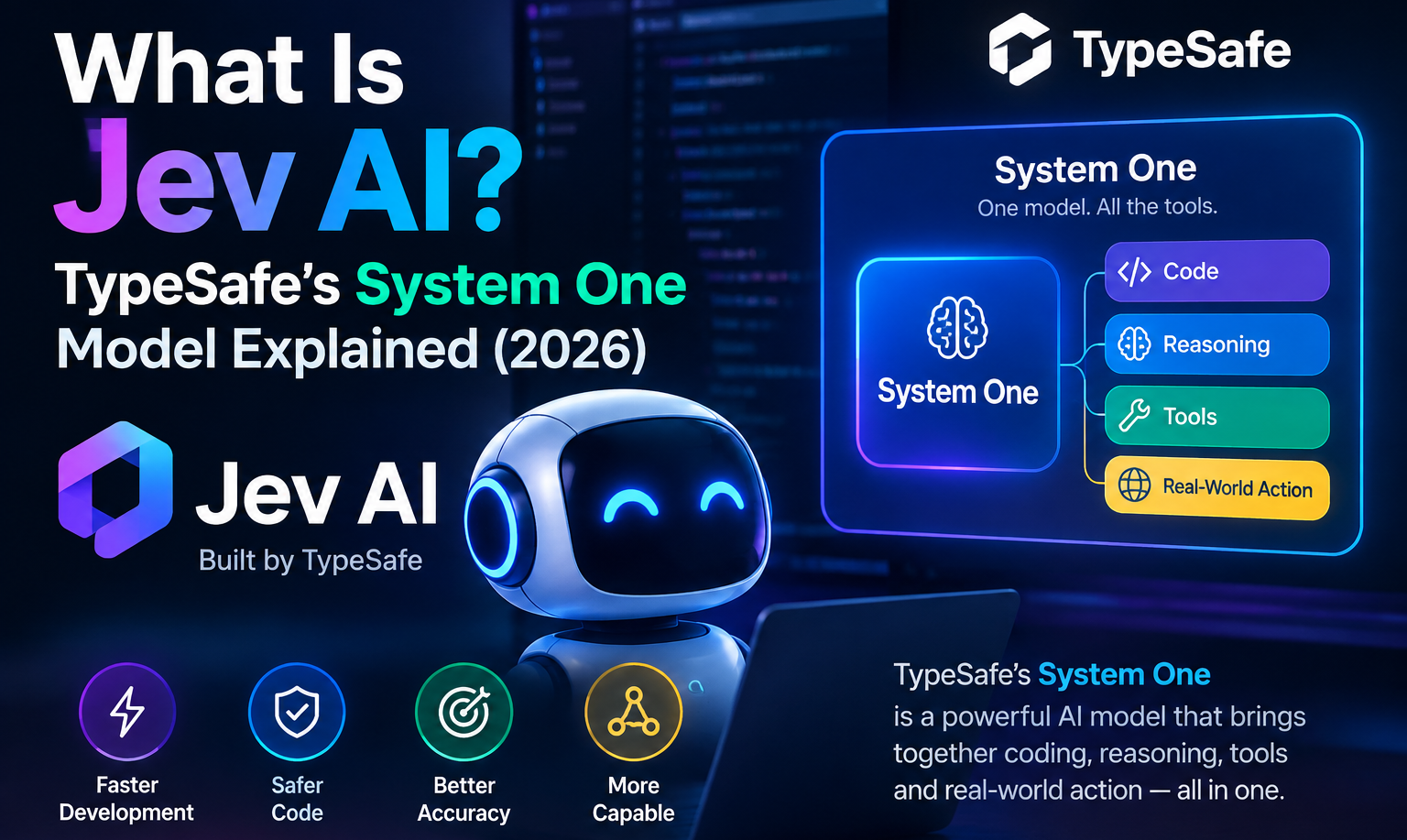
What Is Jev AI? TypeSafe’s System One Model Explained (2026) Meta
Introduction
Most AI tools you hear about, like ChatGPT and Claude, work by writing text. In September 2026, a startup called TypeSafe AI launched something different: a model that never writes a sentence. It is called Jev, and it quickly became one of the most discussed AI releases of the year among developers.
In this article, you will learn what Jev AI is, who built it, how it works, what it costs, where it is useful and, just as important, where it falls short. We also explain how to avoid look-alike websites. If you are new to AI tools in general, start with our guide on How AI Is Transforming the IT Industry in 2026.
What Is Jev AI?
Jev is the first public model from TypeSafe AI, released in early access. Instead of generating text, it takes the current state of an application plus a set of typed questions and returns structured decisions with probabilities. Think of it as a very fast, very smart function call that you can place inside normal software.
TypeSafe AI announced Jev on 15 September 2026 after about two years in stealth. According to reports on the launch, the company also announced a $40 million funding round. Jev is described as a transformer-based model that is not a large language model (LLM).
A simple way to picture it: a chat AI answers “Write me a reply to this customer.” Jev answers “Which category is this message in, and how sure are you?”
Who Is Behind Jev?
TypeSafe AI was founded in 2024. Its leadership, as listed on the AI Engineer conference organization page, is:
- Diogo Almeida, CEO, who previously worked at OpenAI and co-authored the InstructGPT research behind the human-feedback training that helped develop conversational AI
- Erik Gafni, CTO, with experience building production AI systems
- Sasha Sheng, COO, who previously worked in research engineering at Meta/FAIR
You can read more on the AI Engineer page for TypeSafe AI and in this TechCrunch report on the launch. The Latent.Space interview with Diogo Almeida goes deeper into the thinking behind the model.
What Is a System One Model?
The name comes from psychology. Daniel Kahneman described “System 1” as fast, intuitive thinking and “System 2” as slow, deliberate reasoning. TypeSafe applies this idea to AI: many decisions inside software are quick judgments, such as “Which category is this?” or “Is this urgent?”, and do not need a long chain of reasoning or a paragraph of text.
A System One model is built for exactly those quick, repeatable decisions. TypeSafe calls its training method RLCD, short for Reinforcement Learning for Calibrated Decisions. The goal is for the model’s confidence to be honest: if it says it is 90 percent sure, it should be right about 90 percent of the time. According to TechCrunch, the company says Jev was trained only on synthetic data, and it has not shared details of the model’s architecture.
How Jev Works
The process has three simple steps:
- Define the output. You decide in advance what kinds of answers are allowed, such as a category, a yes/no value or a score.
- Send the state. You pass in the context, for example a message, a log or a user profile, along with your typed questions.
- Get typed answers. Jev returns the answers with probabilities. All questions are answered together in one parallel pass instead of word by word.
Because the output must fit the structure you defined, your code can use it directly without parsing messy text. Official materials report response times of roughly 70 to 500 milliseconds.
Key Features
- Typed, structured output. Answers always fit the format you defined, so there is no free-form text to clean up.
- Calibrated confidence. Each answer comes with a probability you can use to decide when to trust it and when to send it to a human.
- Speed. Parallel generation is what makes the 70 to 500 millisecond range possible.
- Low cost. Output tokens are free because the model returns decisions rather than text. Input pricing is covered below.
- Works with other AI. It is meant to sit inside automation and can also act as a check on other AI systems, for example watching LLM agent activity or detecting jailbreak attempts.
Jev vs Traditional LLMs

Real-World Use Cases
- Support ticket routing. Label each message as billing, technical or sales and send it to the right team.
- Data extraction. Pull structured fields such as dates, names or amounts from messy text.
- Content moderation. Score content as it arrives and flag what needs review.
- Guardrails for chatbots. Detect off-topic requests or jailbreak attempts before they reach your main model.
- Monitoring AI agents. Check agent activity cheaply instead of using another expensive LLM.
- Lead and priority scoring. Rank requests by urgency or value.
- Large-scale data labeling. Classify thousands or millions of documents quickly.
How to Get Started
- Go to the official source. Start from TypeSafe’s own website at typesafe.ai and its documentation at docs.typesafe.ai. Confirm the addresses yourself before entering any details.
- Join early access. Jev was released in early access, so availability and features may change.
- Get an API key from the official dashboard and follow the official quickstart and SDK instructions.
- Start with one small task, such as classifying 100 of your own support messages.
- Measure the results. Compare Jev’s answers and confidence scores against your own labels before using it in production.
- Keep a human in the loop for low-confidence or high-stakes decisions.
About pricing: Several launch reports state an input price of $0.042 per million tokens with free output, while the unofficial site jevai.net lists $0.084. Prices can change, so always check the official pricing page.
Limitations and Criticisms
Jev is interesting, but it is not magic.
- “Hallucination-free” needs context. Jev cannot invent a paragraph because it does not write text. But it can still pick the wrong category with high confidence. One analysis noted that a structural guarantee on the format of answers is a more defensible claim than a blanket promise of correctness.
- Not a chatbot. It cannot hold a conversation, write articles or generate code. Reviewers describe it as unsuitable for chat, coding or long-context reasoning.
- Early stage. It launched in September 2026, so independent long-term testing is still limited.
- Many claims come from the company. Figures such as “40 to 400 times cheaper” come from TypeSafe’s own materials. Test on your own data.
- Architecture is undisclosed. The company has not shared details, and outside observers have speculated about what it is built on.
- Needs good design. Results depend on how clearly you define your questions and output types.
A Warning About Unofficial Websites
If you search for Jev AI, you may land on jevai.net. That site’s own footer says it is an independent community resource and is not affiliated with or endorsed by TypeSafe AI. It may still be useful as an explainer, but it is not the official source.
Before signing up for anything or paying anyone:
- Check that you are on TypeSafe’s official domain.
- Be careful with sites that use referral links or promotional banners.
- Never share API keys or payment details on a site you have not verified.
Why Jev Matters for Developers and Freelancers
Even if you never use Jev, the idea behind it is worth understanding: not every AI task needs a chatbot. Many real jobs are small decisions repeated thousands of times, and using a huge text model for each one can be slow and costly.
For developers and freelancers, this opens practical opportunities:
- Build smarter automations for clients, such as ticket routing, lead scoring and content filtering.
- Add AI guardrails to chatbots you create.
- Offer “AI workflow” services that combine a chat model for writing with a decision model for sorting.
- Learn to break big AI tasks into small, measurable decisions, a skill that will stay useful whichever model wins.
For a wider view of how AI fits into web projects, read our article on AI Agents in Web Development.
Frequently Asked Questions
What is Jev AI?
Jev is the first System One model from TypeSafe AI. It takes application state and typed questions and returns structured decisions with calibrated probabilities instead of generated text.
Who created Jev AI?
TypeSafe AI, a company founded in 2024 by Diogo Almeida (CEO), Erik Gafni (CTO) and Sasha Sheng (COO). Almeida previously worked at OpenAI.
Is Jev AI an LLM?
No. It is described as a transformer-based model that is not a large language model, because it does not generate text.
Is Jev AI a chatbot like ChatGPT or Claude?
No. ChatGPT and Claude are conversational assistants. Jev is a decision engine meant to be called from software.
Does Jev AI really have zero hallucinations?
It cannot make up text because it does not produce text, and its outputs always match the format you define. However, it can still make a wrong decision, so verify its accuracy on your own data.
How much does Jev AI cost?
Launch reports cite $0.042 per million input tokens with free output, while the unofficial site jevai.net lists $0.084. Check the official TypeSafe pricing page for current numbers.
Is jevai.net the official Jev AI website?
No. The site states that it is an independent community resource and not affiliated with TypeSafe AI. The company’s own site is typesafe.ai.
Can Jev AI replace ChatGPT or Claude?
No. It does a different job. Chat models handle open-ended writing and reasoning, while Jev handles fast structured decisions.
Can beginners use Jev AI?
It is aimed at developers who call APIs from code. Beginners can still learn the concept and try small experiments after reading the official documentation.
Conclusion
Jev AI is a fresh idea in a crowded field: instead of making AI better at talking, make it better at deciding. If its claims hold up in independent testing, it could make many automated workflows faster, cheaper and easier to trust. But it is early, many figures come from the company itself, and it does not replace chat models.
The smart approach is to stay curious and test carefully. Read the official documentation, try one small task, measure the results and keep a human in charge of important decisions.
Have you tried Jev or another decision-style AI model? Share your experience in the comments. I would love to learn from you.
Related Reading:
- How AI Is Transforming the IT Industry in 2026
- AI Agents in Web Development: Elementor MCP and Claude
- Cybersecurity Basics for IT Professionals
#JevAI #TypeSafeAI #AI #ArtificialIntelligence #MachineLearning #TechTrends